
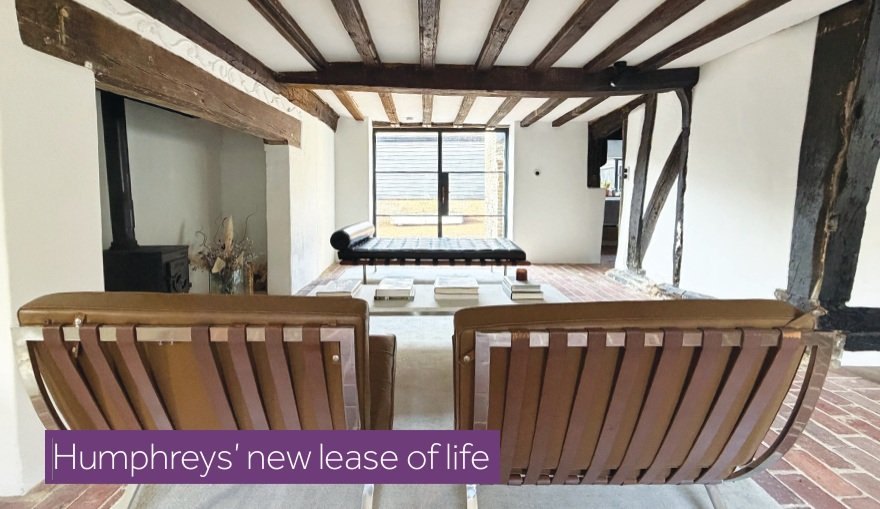
When Humphreys bakery closed its door for a final time in 2019, it marked the end of an era for the village and its residents. And, since the property went on the market and was subsequently sold, villagers have been watching with interest as the historic building has undergone a major restoration to become a stunning home. For many, it’s been hard to resist peeping through the floor to ceiling shop window, to snatch a glimpse as work has progressed. But what lies beyond the former shop and counter has remained a mystery – until now! Earlier this month we joined homeowner Stephen Yeomans for a guided tour of this much-loved building.
By Claire Cooper
Stephen was the perfect candidate to tackle such a mammoth restoration project. If his name doesn’t ring any bells, then maybe the ‘Rusty Metal House’ will. Stephen featured on the popular Grand Designs TV programme back in 2015, following his journey to build an iconic. weathered steel, contemporary home, on a former quarry site on the banks of the River Ouse in Lewes. The property went on to win several prestigious architecture awards.
With many years’ experience in property renovation, Stephen wasn’t at all daunted by the prospect of tackling the medieval High Street bakery, parts of which date back to 1360, “I’ve lived in quite a few historic buildings and always try to find something which has both character and potential,” he said. “I’ve always been interested in architecture and design and like to put my own stamp on a property - I don’t like living with other people’s designs and ideas!”
Stephen bought the property in December 2022 as a future home for himself and his daughters. “As soon as I walked in, I knew this was for me,” he said. “It was such an interesting building, steeped in history, with incredible potential.”
Renovating a Grade II* listed property is a painstaking process and involves working closely with Historic England and conservation officers. Every detail is scrutinised and plans are constantly changing. “The most challenging part of the whole process was meeting the demands of the conservation officer,” Stephen recalled. “It was both frustrating and expensive too. I’ve renovated a Grade II property before, and I think that gave me a false sense of security. I hadn’t fully appreciated that a Grade II* is so close to a Grade I.” But once the plans were finally approved, the rest was plain sailing. “Most of the contractors are people I’ve worked with before, so we just got on with it.”
The first job was to strip the property back to its bare bones to reveal the fabric and construction of the building. Two inglenook fireplaces were exposed along with a multitude of beams, including a stunning vaulted ceiling the in the master bedroom. Original floorboards have been restored and repaired, and a brick floor lowered, levelled, brought back to life and extended using reclaimed bricks.
Every wall has been lime plastered, plumbing has been updated and the whole property has been re-wired Most windows have been replaced to match the originals, and the shop front window fitted with toughened glass, making the High Street property remarkably quiet. The suspended glass window shelves, once adorned with jam doughnuts and cream cakes, tempting customers into the shop, have also been reinstated.
The familiar bakery sign on the shop front was removed and gifted back to the Humphrey family, who have enjoyed meeting Stephen and visiting the renovated property. The original sign, hidden underneath has been restored and left in place. It’s been a labour of love for Stephen and for others working on the restoration. “Many of the builders had fond memories of coming into the shop to buy their lunch,” said Stephen. “They’ve enjoyed chatting to passers-by who were interested in the renovation.” It’s also been an expensive process. “Restoring the roof structure cost around £50,000 and I’ve spent around £10,000 just on skips!” said Stephen. “Sadly, I didn’t find any buried treasure, but it was nice to unearth some quirky and interesting features.”
Stephen has furnished his home with a mix of mid-century and contemporary styles. “I like the juxtaposition between the very old building and modern pieces,” he said. “I’ve tried to respect the building and not fill it with too much stuff, so it looks like it’s had a light touch rather than overdeveloped or re-instated.” An old barn at the rear of the property has also been renovated to become a music studio, housing Stephen’s renovated hi-fi system and impressive vinyl collection. “It’s great to have somewhere to chill out and listen to my music,” he said.
Although the property feels very much like home, Stephen has decided to move on and the property is going on the market in March, for a cool £1,7million. “I had planned to settle here, but my personal circumstances have changed, so I’ll be heading back to Lewes to oversee my next renovation project,” he said. “I feel lucky to have lived here and I’m proud of what I have achieved. I think the house has a nice feel to it - overall, the house has turned out very well.”
For more photos, pick up a copy of March’s Lindfield Life and keep your eyes on our social media channels!

